





Financial products are evolving faster than most organizations can keep up with, and the demands on engineering, product, risk, and compliance teams are increasing simultaneously. As institutions add new use cases, partner integrations, regulatory mandates, and customer experience requirements, the complexity of the underlying product logic grows exponentially. Many teams try to solve this by adding more APIs, more services, or more workflow layers, but these approaches only make systems more fragile and slower to evolve. The real bottleneck is not tooling; it is the absence of a stable, reusable foundation for financial behaviour. This is where FinTech primitives or reusable financial components become essential. They offer a structured way to encode domain logic so that products can scale, evolve, and iterate without constant rework.
What are FinTech primitives?
FinTech primitives are the smallest executable units of financial behaviour. They are not generic functions or code snippets; they encode domain-specific logic with clear rules, compliance constraints, orchestration semantics, and expected state transitions. Everything in a financial product, whether onboarding flows, lending journeys, payment pathways, or risk checks, is constructed from combinations of these atomic behaviours.
Examples of true primitives include generating an OTP, verifying a KYC level, calculating a spend limit, scoring a transaction’s risk, pre-authorising a card payment, posting a ledger entry, or applying interest. Each of these actions represents a discrete piece of financial logic that can operate independently, carry audit context, and compose naturally into larger workflows. A complete product, such as a digital wallet or credit line, emerges from a hierarchical arrangement: primitives form domain blocks, domain blocks form workflows, workflows form product templates, and templates become full production applications.
Why primitives matter in FinTech
Financial products share a surprisingly large amount of underlying logic across categories. More than half of the behavior in any new payment, lending, or onboarding journey resembles logic already used elsewhere in the organization. Without primitives, teams duplicate this behaviour across services and codebases, introducing inconsistencies and expanding the surface area for risk and regulatory issues.
Primitives centralize behavioral rules and eliminate ambiguity. When KYC verification, limit calculation, risk scoring, or settlement behavior is encoded once as a reusable primitive, every product that relies on it inherits the same deterministic rules and compliance posture. This not only reduces engineering effort but also dramatically simplifies auditability and reduces regression risk. Partner integrations also become cheaper because variations are isolated within specific primitives rather than spread across entire workflows. As a result, teams can innovate at the orchestration level rather than constantly rebuilding core logic.
Why reusability drives real advantage
Reusable primitives directly influence engineering, product, operational, and business outcomes. Engineering teams benefit from consistent interfaces and the elimination of duplicated logic, reducing development hours and regression frequency. Product teams gain the ability to experiment rapidly, adjust workflows by swapping primitives, and roll back safely. Operational teams benefit from unified observability, predictable behavior across products, and reduced incident rates. Business leaders see lower cost per new product and faster iteration on pricing, UX, and new product variants. Metrics such as time-to-first-live, regression rates, MTTR, and overall development cost improve significantly when primitives underpin the system. Because primitives work across use cases, they accelerate composition of journeys across payments, lending, onboarding, identity, and other verticals.
Anatomy of a well-designed FinTech primitive
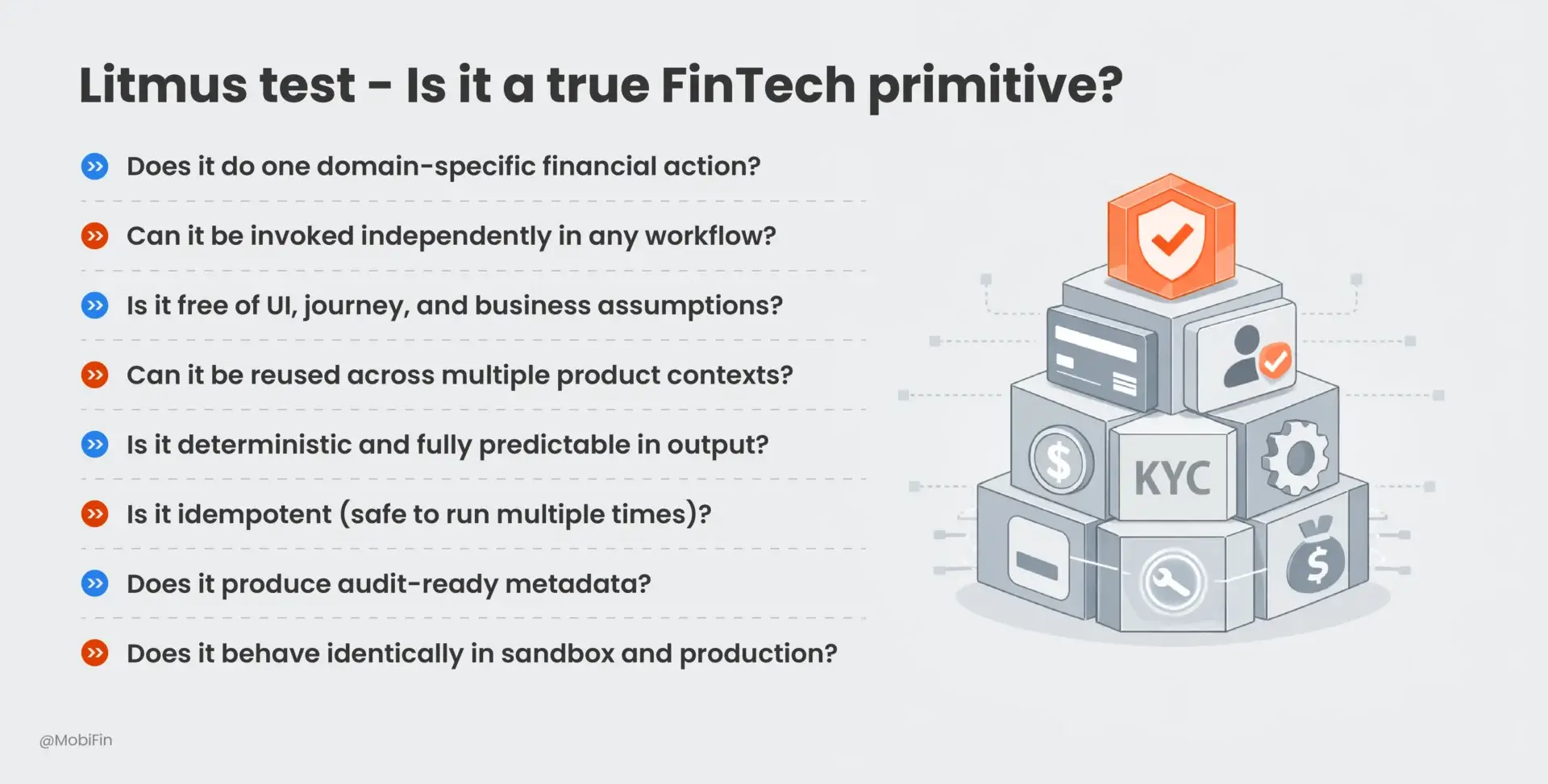
Not every component qualifies as a primitive. To be considered one, it must satisfy a clear set of criteria. It should be atomic, performing only one domain-specific action. It must be idempotent, capable of running multiple times safely without corrupting state. It should be stateless, passing state through rather than storing it internally. It must be composable with other units without tight coupling. Its outputs should be deterministic given specific inputs. It should generate the necessary audit metadata for compliance teams. And importantly, it must behave identically in sandbox, staging, and production environments. A component that fails any of these criteria is not a true primitive and will not scale as part of a robust FinTech architecture.
A simple example is a payment pre-authorization primitive. Its API contract should accept the amount, currency, merchant, user context, and idempotency key, and return a status, authorization identifier, consumed limits, and an audit trace. Nothing inside it should assume the structure of the wider product. It does its job and hands control back to the orchestrator.
How Tapestry implements FinTech primitives
Tapestry applies reusable FinTech primitives as foundational architectural layer. The composable digital experience platform ships with a library of pre-built financial primitives spanning payments, onboarding, lending, identity, KYC, risk, and compliance actions. These primitives operate consistently in sandbox and production because Tapestry uses deterministic orchestration across all environments. Workflows built on Tapestry are simply compositions of these primitives, which ensures consistency, reusability, and auditability across all products. Versioning, governance, rollback, and environment parity are native features. This approach allows institutions to experiment safely, assemble new products in days, and adjust logic without destabilising existing systems.
Patterns and best practices
Organizations adopting the primitives model benefit from adopting reliable composition patterns such as pipeline sequencing, event-driven orchestration, and state machine constructs. Versioning practices such as semantic versioning and controlled deprecation prevent unexpected behavioral drift. Testing strategies, including contract testing, golden-file testing, synthetic data simulation, and environment-parity validation, ensure that primitives behave predictably across all stages of deployment. Security and compliance guardrails, implemented as policy-as-code and supported through standardized audit trails, strengthen the reliability of the entire ecosystem.
Conclusion
As financial institutions scale their product portfolios, the underlying complexity of product logic grows faster than teams can manage. Hardcoded workflows, duplicated rules, and scattered integrations simply cannot keep up with the pace or reliability demands of modern FinTech. Reusable FinTech primitives offer a disciplined, scalable foundation for assembling and iterating on financial products without recreating the same logic in different places. They make innovation faster, compliance more consistent, and engineering dramatically more efficient. By shifting from monolithic, bespoke implementations to a primitive-driven architecture, organizations create systems that compound value rather than rebuild it repeatedly.
This is exactly why we built Tapestry, a composable FinTech platform — to give teams a reusable, orchestrated foundation where financial products can evolve safely, consistently, and at the speed the industry now demands.
To know how Tapestry unlocks the power of FinTech primitives in reimagining financial product innovation, contact us for a demo.