






In the world of modern finance, we’ve moved past the novelty of “digital first.” We are now entering the era of the invisible bank.
Think back to the early 2010s: the goal was simply to get banking onto a smartphone. Today, that is no longer enough. The next frontier is Autonomous Finance – a self-correcting, self-optimizing ecosystem where Agentic AI algorithms don’t just suggest a budget; they execute it. The question dominating leaders across the globe is no longer if banking will become autonomous, but rather “Is Generative AI the missing engine needed to finally build a true ‘Self-Driving Bank’?”
What is a self-driving bank?
A self-driving bank is a financial institution where routine, high-frequency decisions are autonomously executed by AI systems, with humans retaining oversight and control.
Unlike traditional digital banking, a self-driving bank does not wait for users to initiate every action. It proactively manages financial behaviors such as optimizing savings, managing liquidity, approving low-risk credit, routing transactions, and triggering compliance checks, based on real-time context, rules, and risk boundaries.
Importantly, this does not mean the absence of human control. It means shifting human effort away from repetitive decision-making toward supervision, exception handling, and governance.
The autonomous horizon: Beyond automated, toward Intelligent
At its core, autonomous finance is the ultimate fulfillment of contextual banking. It’s the transition from a passive dashboard that tells you what you did, to an active partner that acts smartly on your behalf.
The growth trajectory for this shift is staggering. The global autonomous finance market, valued at USD 12.4 billion in 2023, is projected to soar to nearly USD 90 billion by 2033 (Datahorizzon Research). This isn’t just about efficiency; it’s about a scalable architecture that can handle millions of micro decisions per second – decisions that were previously left to human error or, worse, ignored altogether.
Autonomous banking vs automation — Why the difference matters
Automation follows predefined rules, whereas autonomy operates within defined boundaries.
An automated bank executes tasks when triggered, whereas an autonomous bank evaluates context, weighs options, and acts within approved constraints.
This distinction is critical – Automation improves efficiency, whereas autonomy changes operating models.
Generative AI: The brain of the “self driving” machine
While standard AI is excellent at pattern recognition (e.g., spotting fraud in a digital wallet), Generative AI brings “reasoning logic” to the table. It allows a digital banking platform to move beyond binary “if then” rules.
In a recent industry shift, we’ve seen major global players move away from generic AI builders. Why? Because financial logic isn’t “just code”, it’s a regulated behavior.
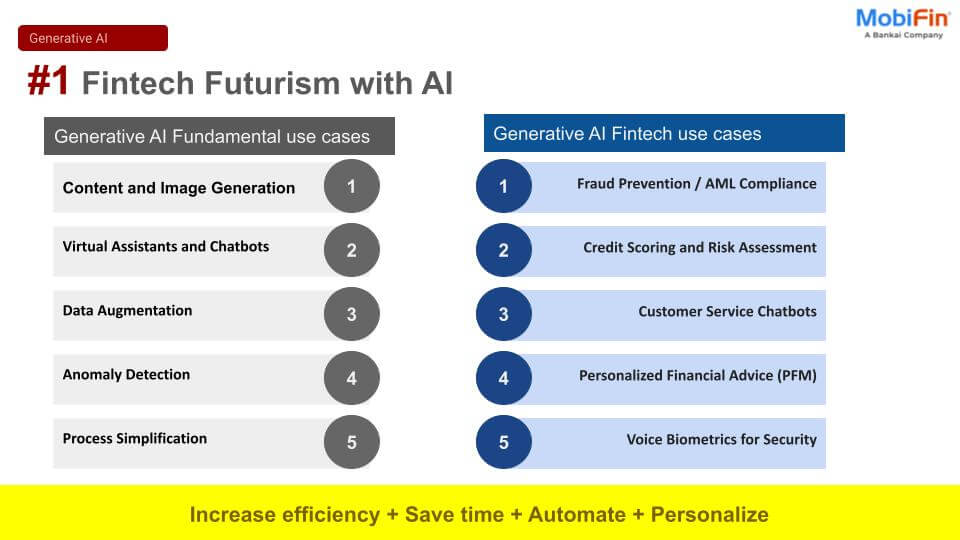
Across global banks and FinTechs, generative AI is being applied in a small number of high-impact areas that go beyond experimentation and into production.
These include synthetic credit data generation, where AI simulates millions of borrower personas to stress-test lending systems without exposing real customer data; and hyper-personalized behavioral orchestration, where AI moves beyond generic advice to contextual financial action — not “you should save more,” but “I’ve moved $47 into your high-yield account because your weekend spending was lower than projected.”
Alongside this, generative AI is driving decision augmentation, executing low-risk approvals across lending, limits, and settlements with minimal human intervention. In parallel, it is accelerating code modernization by translating decades-old COBOL logic into modern, modular microservices in weeks rather than years.
The missing link: Why Gen AI needs composable banking
There’s a recurring bottleneck in composable banking: AI is only as smart as the infrastructure it sits on. You cannot run a “self-driving” engine on a rigid, monolithic chassis.
To enable a self-driving bank, your architecture must be broken down into reusable primitives – independent modules such as KYC, interest calculation, and settlement.
- In regions like Europe and Asia, banks adopting a composable approach have seen a 30-40% reduction in time to market AI driven features.
- In India, the DPDP Act and RBI’s evolving stance on AI mean that autonomy must be built with “Explainability” at its heart.
A composable system allows you to audit the specific module that made a decision, rather than investigating a “black box.”
Why Generative AI fails on monolithic banking systems
Generative AI cannot operate safely inside tightly coupled systems.
When logic, data, and workflows are hardwired together:
- Decisions cannot be isolated
- Outcomes cannot be explained
- Accountability becomes unclear
Composable banking solves this by exposing discrete, auditable primitives that AI can orchestrate—without violating regulatory or operational boundaries.
The “self-driving” reality check: A human centric perspective
Will banks truly become “self-driving”? Our data-backed opinion is: Partially, but profoundly.
We are heading toward a “Human in the Loop” autonomy, where AI takes responsibility for the majority of high-volume, low-risk decisions. For 90% of daily transactions like liquidity management for agent networks, micro lending approvals, or cross border settlement – AI can operate with speed and consistency that humans cannot match.
This frees up the human “drivers” (the CXOs and relationship managers) to handle the complex 10% where judgment, accountability, and ethics matter most: Strategic risk decisions, high-value relationship and wealth management, regulatory responsibility, exceptions and disputes, nuanced corporate restructuring, and the ethical governance of the AI itself.
Security and compliance considerations
Generative AI in banking is not inherently risky, uncontrolled autonomy is.
For AI-driven systems to operate safely in financial environments, they must be designed with accountability built into every decision they make. This starts with explainable decision logic, where outcomes can be traced back to specific rules, data inputs, and model reasoning. It extends to auditable workflows, ensuring every automated action can be reviewed, reconstructed, and challenged when required.
Equally critical are data minimization and consent controls, which limit exposure while respecting customer privacy, and human override mechanisms that allow institutions to intervene when edge cases, anomalies, or ethical concerns arise.
Regulatory frameworks such as the European Union AI Act, Reserve Bank of India guidelines, and India’s Digital Personal Data Protection Act are converging on a single, non-negotiable principle: autonomy without accountability is unacceptable in financial systems.
This is where composable architecture becomes decisive. By breaking banking logic into discrete, governable primitives, institutions can enable AI-led automation while preserving transparency, control, and regulatory confidence. Accountable autonomy is not achieved through models alone; it is enforced through architecture.
The strategic imperative for leaders
For the VPs and CXOs reading this, the path to autonomous finance isn’t a leap of faith; it’s a journey of architectural refinement.
- Create “primitives” instead of “apps”: Make sure your online banking system is sufficiently modular to be controlled by an AI.
- Concentrate on Engagement Suites: Connect your “transactional banking” and “lifestyle ecosystems” using Generative AI.
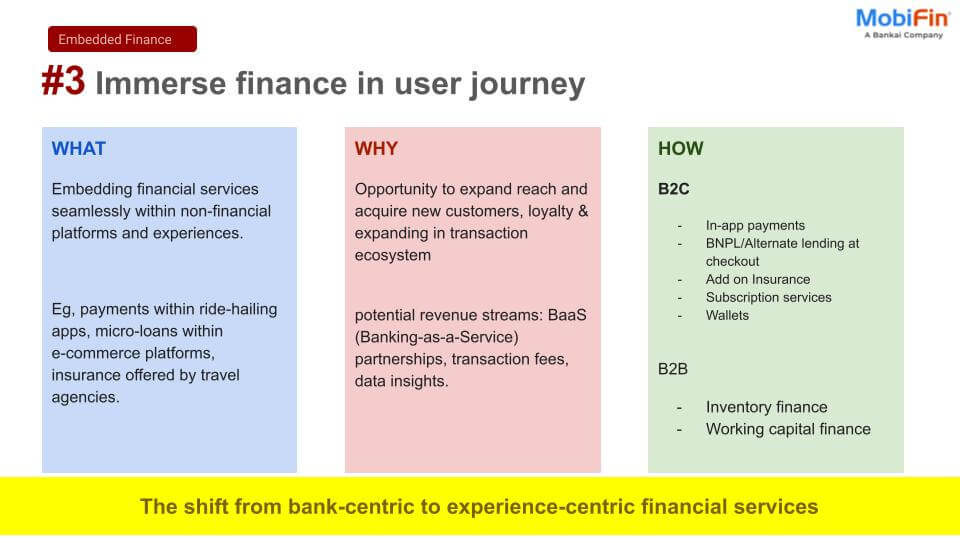
- Get ready for the regulation of embedded finance. Your compliance needs to become autonomous as banking becomes invisible.
Conclusion: Shaping the future together
The “Self-Driving Bank” isn’t just a tech trend; it is the future of financial inclusivity and operational excellence. At MobiFin, we believe that by fusing a fusion of banking and FinTech into a single, composable platform, we aren’t just observing this shift – we are actively building the infrastructure that makes it possible.
The road to autonomous finance is paved with APIs, powered by Gen AI, and governed by trust. Is your institution ready to let go of the manual steering wheel?
Frequently asked questions
Generative AI in banking refers to AI systems that can reason, generate decisions, and trigger actions across financial workflows within defined risk and regulatory boundaries.
raditional AI focuses on prediction and detection, while generative AI enables decision-making, orchestration, and adaptive behavior across banking processes.
A self-driving bank is a financial institution where routine, high-volume decisions—such as savings optimization, low-risk credit approvals, and liquidity routing—are autonomously executed by AI with human oversight.
No. Banks are moving toward partial autonomy, where AI handles routine decisions and humans retain control over complex, high-risk, and ethical outcomes
Common use cases include synthetic credit data generation, personalized financial nudges, fraud prevention, automated compliance checks, and legacy system modernization.
Yes, when deployed with explainable decision logic, auditable workflows, strict data controls, and human override mechanisms.
Banks ensure accountability by using modular, composable systems where AI decisions can be traced to specific data inputs, rules, and functional components.
AI in banking is governed by frameworks such as the EU AI Act, central bank guidelines, and data protection laws that emphasize transparency, auditability, and human accountability. Many such frameworks are evolving across different regions.
Composable banking allows AI systems to interact with discrete, auditable primitives, enabling controlled autonomy instead of opaque, black-box decision-making.
Yes, but its effectiveness is limited unless legacy systems are exposed through APIs or modularized to support explainability and control.
Humans remain responsible for oversight, exception handling, ethical governance, and final accountability for AI-driven decisions.
Banks should modularize their architecture, embed explainability and auditability, align AI adoption with regulation, and introduce autonomy through supervised use cases.