For banks and financial service providers, launching a digital wallet presents a strategic decision: should the organization build the platform in-house or use a Digital Wallet as a Service (WaaS) provider?
An in-house build offers direct control over architecture, development priorities, and product differentiation. A WaaS approach can provide an existing technology foundation, reducing the amount of infrastructure the organization needs to create and maintain itself.
Neither approach is automatically better. The right decision depends on the organization’s capabilities, delivery deadlines, regulatory obligations, integration requirements, long-term roadmap, and appetite for technology ownership.
The market context makes the decision increasingly important. The World Bank’s Global Findex 2025 reports that global account ownership reached 79% of adults, yet approximately 1.3 billion adults remained without financial accounts. Meanwhile, GSMA reported that mobile-money services processed more than US$2 trillion in transactions during 2025. These figures describe the broader financial-inclusion and mobile-money markets, not the performance of WaaS providers specifically. They nevertheless illustrate the growing relevance of accessible digital financial services.
The decision is not simply about comparing a vendor’s subscription fee with an internal development budget. It is about comparing the full cost, time, risk, and control of two different operating models.
What Is Digital Wallet as a Service?
Digital Wallet as a Service is a delivery model in which a service provider partners with a solution provider that offers a white-label platform to operate a digital wallet with end-to-end technology.
Depending on the provider and agreement, the offering may include wallet functionality, user onboarding, transaction processing, APIs, administrative tools, reporting, security capabilities, and integrations with selected payment systems.
The customer organization configures and operates the service according to its business model, regulatory responsibilities, and contractual arrangements.
The term does not describe a single standardized product. One provider may offer a largely ready-to-configure platform, while another may require substantial customization and integration work.
This distinction matters. A solution marketed as WaaS should be assessed against the specific services it actually delivers, the components the customer must supply, and the responsibilities that remain with each party.
What Does an In-House Build Involve?
An in-house build means the organization takes primary responsibility for designing and developing the wallet platform, either through its own engineering team or with development partners under its direction.
The organization may need to build or integrate:
- Mobile and web applications.
- Identity, authentication, and account-management services.
- Wallet ledger and transaction-processing capabilities.
- APIs and integrations with banking systems.
- Payment-rail and third-party connections.
- Fraud monitoring and security controls.
- Administrative and operational dashboards.
- Reconciliation and reporting.
- Testing, deployment, monitoring, and disaster recovery.
The exact scope depends on what already exists. A bank with mature API infrastructure, a suitable ledger, and an experienced digital-banking team may have a different starting point from a new financial service provider.
An in-house build can make sense when the wallet is strategically differentiating, existing systems can be reused, and the organization has the skills and resources to maintain the platform over time.
However, owning the code is only one aspect of control. The organization must also fund upgrades, respond to vulnerabilities, maintain integrations, and support the service throughout its lifecycle.
Compare Total Cost of Ownership, Not Just Initial Price
Cost is often the most visible difference between the two models, but headline prices can be misleading.
An in-house project may require engineering salaries, architecture, design, infrastructure, security testing, third-party licenses, integration work, quality assurance, and ongoing maintenance.
A WaaS arrangement may introduce subscription fees, implementation charges, transaction-based pricing, integration costs, premium support, or charges for additional services.
A meaningful comparison should include the following cost categories.
Initial delivery costs
For an in-house build, include product design, engineering, infrastructure setup, security reviews, testing, and integration. For WaaS, include configuration, onboarding, integration, migration, training, and any customization.
Recurring technology costs
Include infrastructure, monitoring, maintenance, support, software subscriptions, licenses, and upgrades.
Transaction-related costs
Assess any per-transaction charges, payment-provider fees, settlement costs, or usage tiers.
Risk and compliance costs
Include security assessments, audits, regulatory changes, incident response, and the staff needed to oversee the service.
Future development costs
Consider how much it will cost to add payment methods, new customer journeys, additional markets, or new integrations.
Exit and migration costs
If the relationship ends, the organization may need to migrate data, replace integrations, rebuild certain components, and transition customers.
A practical financial model should compare costs over a common period, such as three to five years, using realistic transaction volumes and growth assumptions. The model should also include implementation risk and the cost of delaying the launch.
Time-to-Market: Where Can a WaaS Provider Help?
A provider with an established platform may reduce the amount of foundational software that must be designed, developed, and tested from scratch.
This can be particularly valuable when the organization needs to launch a defined set of wallet services quickly or when internal engineering resources are limited.
However, an existing platform does not eliminate implementation work.
The timeline still depends on requirements, core-system integration, payment-provider onboarding, security reviews, data migration, compliance approvals, testing, and user acceptance.
An in-house build may take longer when much of the infrastructure must be created from scratch. But an organization with reusable components and an experienced team may be able to build specific functionality efficiently.
Instead of accepting a generic promise of faster deployment, compare delivery plans with the same scope.
Ask each option to estimate the time required to achieve a defined milestone: a production-ready wallet supporting agreed customer journeys, required integrations, operational controls, and launch-readiness testing.
Control and Customization: Who Decides What Changes?
An in-house build usually provides greater direct control over source code, architecture, release timing, and technical priorities.
That control can be important when the wallet is central to a bank’s competitive strategy or requires specialized transaction logic.
A WaaS provider may offer configuration options, APIs, customization services, and product roadmaps. But some changes may depend on the provider’s release schedule or require additional commercial agreements.
The right questions are specific:
- Can the organization change the customer experience independently?
- Can it configure transaction rules and limits?
- Can it integrate with the required payment providers?
- Who controls release timing?
- How are custom features maintained after platform upgrades?
- What happens if a required feature is not on the provider’s roadmap?
- Can the organization access its data and migrate it to another platform?
The aim is to distinguish control over business decisions from control over the underlying technology. A provider may offer significant flexibility without transferring ownership of the platform, while an in-house build may offer technical ownership but still depend on external infrastructure or payment networks.
Security, Compliance, and Operational Responsibility
Using WaaS does not automatically transfer regulatory responsibility to the vendor. An organization must understand which activities it is legally responsible for and which services are delivered by its technology partners.
The agreement should define responsibilities for data protection, security incidents, access controls, monitoring, audit support, business continuity, and incident reporting.
The organization should evaluate the provider’s security processes, testing practices, infrastructure, access management, vulnerability handling, and disaster-recovery arrangements.
An in-house build offers direct control over many implementation decisions, but it also requires the organization to maintain the relevant expertise and operational capabilities.
In either model, security needs to be designed and tested across the entire system—including mobile applications, APIs, backend services, integrations, and third-party dependencies.
Integration: The Hidden Driver of Cost and Complexity
A wallet rarely operates in isolation.
It may need to connect to a core banking system, payment switch, card processor, identity provider, fraud platform, merchant ecosystem, or external bill-payment service.
The cost of these integrations can be significant in either model.
For WaaS, check whether the required connectors already exist, whether they have been used in comparable environments, and whether they are included in the proposed scope.
For an in-house build, assess whether the organization already has reusable APIs, middleware, security patterns, and integration expertise.
Interoperability also deserves attention. The Bank for International Settlements’ work on API harmonization highlights how fragmented standards can increase costs and processing time and create additional opportunities for errors.
A platform’s ability to connect to required systems—and to manage errors, timeouts, and reconciliation—is often more important than the number of features shown in a product presentation.
Scalability and Long-Term Product Strategy
A wallet that begins with basic transfers may later add merchant payments, bill payments, loyalty services, additional currencies, or new customer segments.
The platform should support the expected roadmap without introducing disproportionate complexity or cost.
An in-house platform can be tailored to the organization’s long-term architecture, but future enhancements remain its responsibility.
A WaaS platform can provide reusable capabilities and ongoing product development, but the organization needs confidence that the provider’s roadmap will support its priorities.
Ask how the solution handles higher transaction volumes, additional integrations, new payment methods, new markets, and changes to regulatory requirements.
Also consider portability. The ability to export data, transition integrations, and migrate customers can help reduce long-term dependency on a single provider.
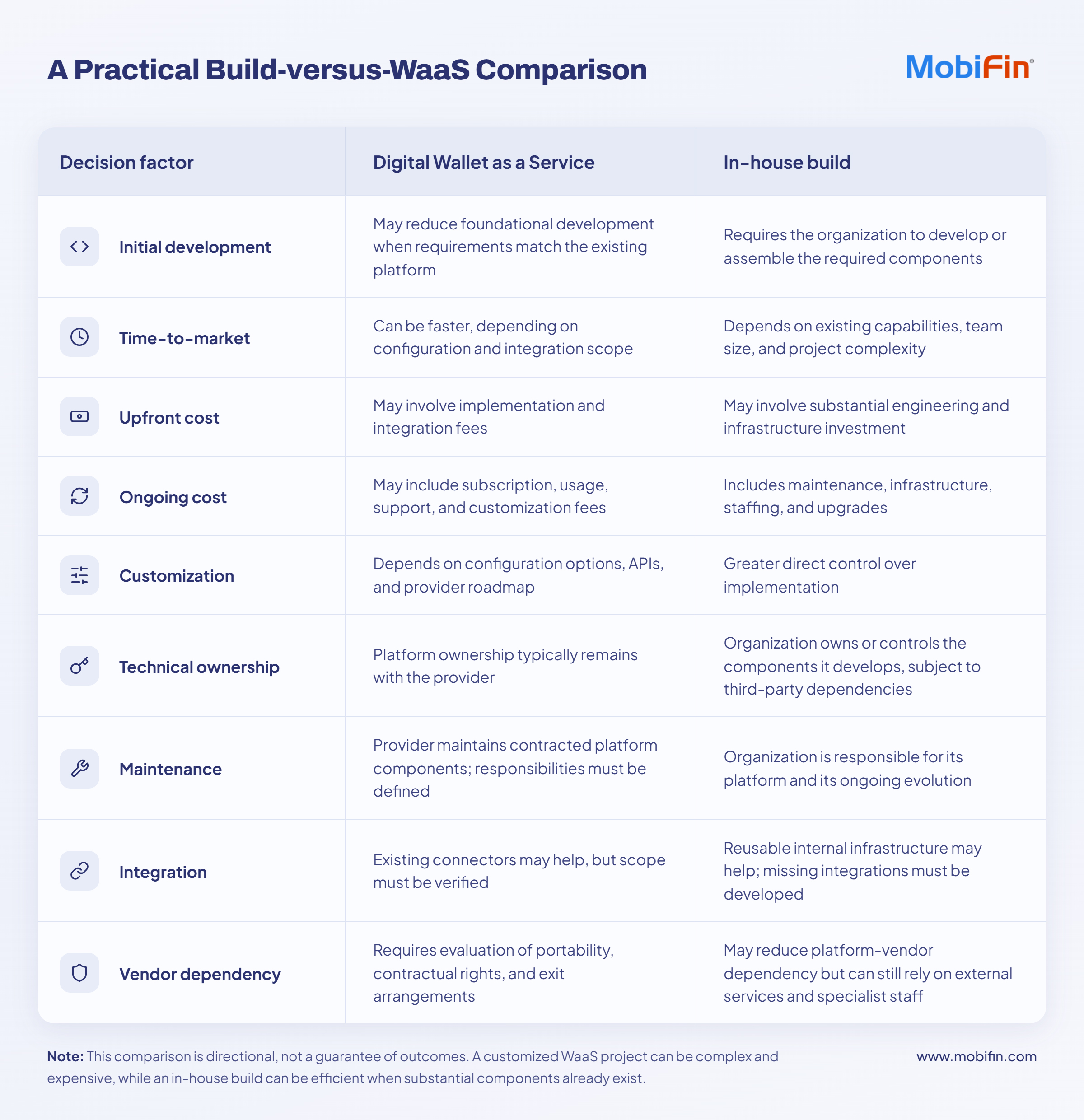
When Should You Choose Each Model?
WaaS may be appropriate when:
- The organization wants to launch a defined wallet proposition without building every foundational component.
- Internal engineering capacity is limited.
- A provider already supports the required integrations and operating model.
- The organization values access to an established platform and contracted maintenance.
- The commercial model remains viable at expected transaction volumes.
An in-house build may be appropriate when:
- The wallet’s architecture or transaction logic is strategically differentiating.
- The organization has experienced engineering, security, and operations teams.
- Existing systems can be reused effectively.
- The organization needs direct control over release schedules and technical direction.
- Long-term platform ownership justifies the investment and responsibility.
A hybrid approach is also possible. An organization may use an external platform for selected wallet capabilities while retaining ownership of its customer experience, integration layer, risk systems, or other strategic components. Whether this is practical depends on the platform’s architecture and contractual terms.
Run a Structured Evaluation Before Committing
A sound evaluation should begin with a defined product scope and a realistic forecast.
Document the required customer journeys, transaction types, integrations, expected volumes, security controls, reporting needs, and launch milestones.
Then ask shortlisted providers and internal teams to respond to the same requirements.
Use a proof of concept to test critical workflows, especially transaction failures, duplicate requests, reconciliation, authentication, and integration with required systems.
Finally, compare the financial model over a common period. Include implementation, ongoing operations, future enhancements, and exit costs.
The decision should be based on evidence rather than on the assumption that buying is always cheaper or building always provides better control.
Conclusion: Choose the Operating Model That Fits Your Strategy
Digital Wallet as a Service and in-house development represent two different ways of delivering a financial product.
WaaS can provide an established technology foundation and potentially reduce the work required to launch. An in-house build can offer greater direct technical control and flexibility, provided the organization can support the platform throughout its lifecycle.
The most useful comparison considers total cost of ownership, time-to-market, integration complexity, security, customization, operational responsibility, and future product strategy.
For banks and financial service providers, the objective is not simply to choose between buying and building. It is to select an operating model that delivers the required customer experience while remaining secure, sustainable, and adaptable as the business grows.
If you are looking for incorporating a digital wallet, we would love to connect.