They can allow users to hold digital assets, transfer value across blockchain networks, convert crypto into fiat currency, and access services through a single interface. For wallet providers, fintechs, and financial institutions, these capabilities introduce a set of interconnected responsibilities around asset custody, transaction execution, compliance, and operational control.
The regulatory focus is also intensifying. In March 2026, the Financial Action Task Force (FATF) reported that more than 250 stablecoins were in circulation by mid-2025, with a combined market capitalization exceeding $300 billion. Its report highlighted money- laundering risks associated with stablecoins, particularly peer-to-peer transfers through unhosted wallets.
Building a crypto-enabled wallet therefore requires decisions that extend well beyond its interface. Providers need to determine who controls the assets, how conversions are executed, which risks are monitored, and how compliance requirements are applied across the entire transaction journey.
Understanding the crypto-enabled wallet
A crypto-enabled digital wallet provides access to digital assets through an application or connected service. Depending on its design, it may support cryptocurrencies, stablecoins, tokenized assets, or transfers between digital assets and conventional currencies.
The wallet itself generally does not hold the assets in the way a physical wallet holds cash. It manages the cryptographic keys or access mechanisms used to control assets recorded on a blockchain. The exact arrangement depends on whether the wallet is self-custodial or managed by a third party.
A crypto-enabled wallet may support several functions:
- Asset storage and access: Managing keys and authorizing transactions.
- Crypto transfers: Sending and receiving digital assets across supported networks.
- Conversion: Exchanging crypto for fiat currency or another supported digital asset.
- Payment functionality: Using supported digital assets to pay merchants or transfer value.
- Compliance controls: Applying identity verification, transaction monitoring, risk checks, and relevant reporting requirements.
- Transaction records: Maintaining information needed for reconciliation, customer support, audits, and regulatory obligations.
These functions are closely connected. A conversion may require a custody arrangement, a liquidity provider, a blockchain transaction, a fiat payment rail, and compliance checks. The wallet provider needs to coordinate these elements while maintaining a consistent record of the transaction.
Custody: Who controls the assets?
Custody is one of the most consequential decisions in crypto-wallet design. It determines who controls the private keys, who can authorize transactions, and who bears responsibility for protecting access to the assets.
There are two principal models.
Self-custody
With self-custody, the user controls the private keys. The wallet provider may supply the software interface and transaction tools, but the user retains control over the keys used to authorize transactions.
This model offers users greater direct control over their assets. However, it also places responsibility on them to protect their keys and recovery information. If access is lost and no effective recovery method exists, the assets may become inaccessible.
For wallet providers, the design priorities include secure key generation, encrypted storage where applicable, recovery mechanisms, transaction previews, and protection against malicious applications or compromised devices.
Third-party custody
In a custodial model, a service provider manages the private keys on behalf of customers. This can simplify the user experience and enable account recovery, transaction controls, and support services.
It also creates additional obligations. The provider must protect customer assets, restrict unauthorized access, maintain accurate ownership records, and establish procedures for withdrawals, disputes, incidents, and service interruptions.
A custodial arrangement should clearly define whether customer assets are segregated, whether they can be used for lending or other purposes, and what happens if the provider becomes insolvent. The legal treatment of customer assets varies by jurisdiction and contractual arrangement.
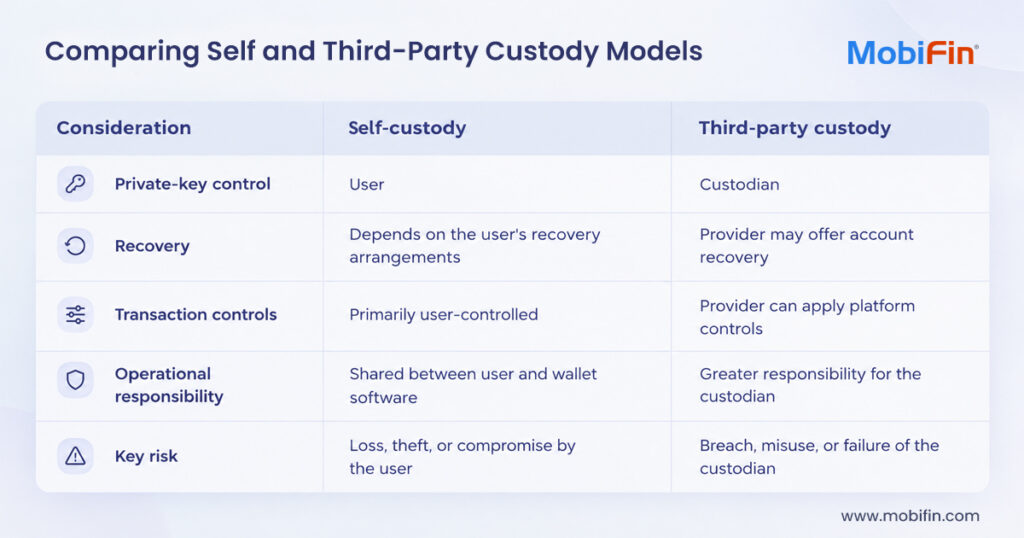
Neither model removes risk. The appropriate choice depends on the product’s intended users, operating model, jurisdiction, and risk appetite.
For a fintech building a crypto-enabled wallet, custody should be decided early because it affects the architecture, customer disclosures, compliance responsibilities, and partnerships required to launch the product.
Conversion: Connecting digital assets to fiat currency
Conversion is the process that allows users to exchange crypto for fiat currency, such as dollars or euros, or to exchange one digital asset for another.
It can make a wallet more useful for customers who need to move between digital assets and conventional financial services. However, conversion introduces several dependencies that the wallet must manage.
A typical crypto-to-fiat journey may involve:
- 1. The customer selects an asset and enters the amount to convert.
- 2. The wallet obtains a quote from an exchange, liquidity provider, or other authorised partner.
- 3. Applicable identity, transaction, sanctions, and risk checks are performed.
- 4. The customer confirms the quoted rate, fees, and transaction terms.
- 6. Fiat funds are delivered through the supported banking or payment rail.
- 7. The wallet records the transaction, fees, settlement status, and final balances.
The sequence can vary depending on the asset, blockchain, provider, and jurisdiction.
Liquidity, pricing, and settlement
Conversion depends on access to sufficient liquidity at an acceptable price. Providers must account for market movements, spreads, network fees, provider charges, and settlement delays.
A quoted conversion rate may change before execution, depending on the service’s pricing model. Customers should be shown the applicable rate, fees, and amount they will receive before confirming the transaction, where the product and rules require it.
Settlement also needs careful handling. A blockchain transaction may be confirmed while the corresponding fiat transfer remains pending. The wallet must distinguish between initiated, pending, completed, failed, and reversed operations where reversals are supported.
Without clear transaction states and reconciliation, discrepancies can arise between the customer’s displayed balance, the blockchain record, and the provider’s settlement records.
Stablecoins and conversion infrastructure
Stablecoins are digital assets designed to maintain stable value relative to a reference asset, commonly a fiat currency. They can be used to transfer value on supported blockchain networks, but their price stability, redemption arrangements, reserve quality, and legal treatment depend on the specific stablecoin.
For wallet providers, stablecoin support requires decisions about which assets and networks to support, how redemption works, which counterparties provide liquidity, and how transfers are monitored.
A wallet should not assume that every stablecoin can be redeemed at par, at any time, or through every provider. Those conditions need to be established for each supported asset and service.
Compliance: Applying controls across the transaction journey
Crypto-enabled wallets operate in a regulatory environment that varies by jurisdiction, asset type, custody model, and the activities performed by the provider.
Depending on the business model and local law, a wallet provider may fall within the scope of virtual asset service provider, crypto-asset service provider, money transmission, payment services, or other regulatory requirements.
Compliance needs to be considered across the complete customer and transaction lifecycle.
Customer identity and due diligence
Where required, providers need processes for customer identification, verification, due diligence, risk classification, and ongoing review.
The depth of these checks may depend on the customer, jurisdiction, transaction pattern, and applicable rules. Providers also need to identify business customers and beneficial owners where relevant.
Transaction monitoring
Transaction monitoring can examine activity such as:
- Transfers involving sanctioned addresses or high-risk entities.
- Unusual transaction frequency, amounts, or movement patterns.
- Rapid movement of funds across multiple wallets.
- Repeated conversions or transfers that do not align with the customer's expected activity.
- Connections to wallets or services associated with known illicit activity.
Blockchain analytics can help identify relationships between addresses and transactions. However, an address alone does not always establish the identity or intent of the person controlling it. Risk signals need to be assessed alongside available customer information and other evidence.
The Travel Rule
The FATF Travel Rule requires covered institutions and service providers to obtain and transmit specified originator and beneficiary information for qualifying virtual asset transfers, subject to the applicable standards and thresholds.
Implementation remains uneven across jurisdictions. In its July 2026 update, FATF reported that 83% of surveyed jurisdictions had passed legislation implementing the Travel Rule, up from 73% in 2025. It also identified continued gaps in implementation, supervision, and enforcement.
For wallet providers, compliance may require identifying whether a transfer falls within scope, collecting the required information, exchanging it securely with relevant providers, and handling missing or incomplete information.
Transfers involving self-hosted wallets can require additional risk assessment and procedures, depending on the applicable jurisdiction and transaction circumstances.
Sanctions screening and reporting
Providers may need to screen customers, counterparties, transactions, and wallet addresses against applicable sanctions restrictions. They also need processes for investigating alerts, escalating suspicious activity, submitting required reports, and retaining records.
These obligations should be built into operational workflows. A policy document alone does not ensure that controls are applied consistently when transactions are initiated, converted, transferred, or settled.
The growing risks around stablecoins and unhosted wallets
Unhosted wallets allow users to control their own private keys without relying on a custodial intermediary. They can support legitimate personal transfers and direct participation in blockchain networks, but they can also complicate oversight because no regulated wallet provider necessarily controls both sides of a transaction.
FATF’s March 2026 report identified peer-to-peer transactions through unhosted wallets as a particular area of concern in the misuse of stablecoins. It called for stronger risk mitigation and effective implementation of anti-money-laundering and counter-terrorist- financing standards.
This creates a practical challenge for wallet providers. A transfer may involve an external address about which the provider has limited information. The provider may need to assess available blockchain data, customer context, transaction history, and relevant risk indicators before deciding how to proceed.
Controls should be proportionate to the risk and consistent with applicable law. They should also account for false positives, since legitimate customers can transact with unfamiliar addresses or use privacy-preserving tools for lawful reasons.
A well-designed process defines how alerts are investigated, when additional information is requested, when a transaction may be delayed or rejected, and when a case must be escalated. It should also preserve a clear record of the rationale behind material decisions.
Building compliance into the wallet architecture
Custody, conversion, and compliance are often managed by different providers or technical components. A wallet may depend on a custody service for key management, a liquidity provider for exchange, a blockchain node or infrastructure provider for transaction execution, a banking partner for fiat settlement, and specialist services for identity verification and blockchain analytics.
Each integration adds dependencies and potential failure points.
A robust architecture needs to coordinate these services while maintaining clear ownership of each control.
Key architectural considerations include:
- Service integration: Connect custody, exchange, blockchain, banking, identity, and analytics providers through well-defined interfaces.
- Transaction orchestration: Manage the sequence of checks, approvals, transfers, conversions, and settlement events.
- Policy enforcement: Apply limits, eligibility requirements, risk thresholds, and approval rules consistently.
- Balance and ledger management: Reconcile customer balances against custody records, blockchain activity, fees, and fiat settlement.
- Exception handling: Define what happens when a provider is unavailable, a transaction remains pending, or a compliance check fails.
- Auditability: Record relevant events, decisions, approvals, and transaction references for investigation and regulatory review.
- Operational resilience: Establish monitoring, incident response, recovery procedures, and clear escalation paths.
These controls become particularly important when a wallet supports several assets, multiple blockchain networks, and more than one conversion or custody partner.
A provider may need to update a compliance rule, replace a liquidity partner, add a supported network, or introduce a new transaction type. The system should make these changes manageable without weakening existing controls or disrupting unrelated wallet functions.
Choosing partners and defining responsibilities
Many wallet providers do not build every capability themselves. They may rely on external custodians, exchanges, liquidity providers, payment processors, blockchain analytics companies, and identity verification services.
Partnerships can accelerate implementation, but they do not automatically remove the wallet provider’s responsibilities.
Before integrating a partner, teams should establish:
Custody and asset protection: Who controls the keys? How are assets safeguarded? Are customer assets segregated? Can assets be lent, pledged, or reused?
Conversion and settlement: How are rates quoted? What fees apply? Who bears settlement risk? How are failed or delayed transactions handled?
Compliance responsibilities: Which party performs customer checks, sanctions screening, transaction monitoring, reporting, and Travel Rule information exchange? Which obligations remain with the wallet provider?
Data and audit access: Can the provider retrieve the records needed for investigations, customer support, reconciliation, and regulatory reviews?
Continuity and exit arrangements: What happens if a partner becomes unavailable, loses authorization, or cannot continue providing the service? How can assets and operations be transferred safely?
These questions should be addressed in contracts, technical designs, operating procedures, and contingency plans.
Designing a wallet that can evolve
Crypto-enabled wallets may begin with a narrow set of functions, such as receiving a stablecoin or converting an asset into fiat currency. Over time, the product may expand to support additional assets, networks, payment methods, custody models, or customer segments.
Each addition can introduce new dependencies and compliance requirements.
A modular product architecture can help teams introduce capabilities in a controlled way. Custody, conversion, identity, monitoring, and transaction orchestration can be managed as distinct capabilities while sharing consistent policies, transaction records, and operational oversight.
For example, adding a new conversion provider may require new API connections, pricing rules, settlement handling, and partner due diligence. Adding a new blockchain network may require network-specific validation, transaction monitoring, fee handling, and recovery procedures.
The objective is to make product changes easier to manage while keeping control requirements explicit. Reusable workflows and integration components can reduce duplicated development, provided each new asset, provider, and jurisdiction is assessed on its own requirements.
Conclusion: The foundations of a trusted crypto wallet
Crypto-enabled wallets bring together digital asset custody, conversion, payment infrastructure, and compliance in a single customer experience. Each capability depends on reliable execution, clear responsibilities, and controls that match the risks of the service.
The regulatory direction reinforces this requirement. FATF’s 2026 updates point to continued gaps in virtual asset oversight, including the implementation of the Travel Rule and risks associated with stablecoins and unhosted wallets.
For fintechs and financial institutions, the next step is to define the operating model before expanding the feature set. That means selecting the appropriate custody arrangement, establishing reliable conversion and settlement processes, assigning compliance responsibilities, and ensuring that transaction activity can be monitored and reconstructed.
A crypto-enabled wallet can only operate effectively when its underlying services work together. The quality of that foundation will shape how safely the wallet can expand into new assets, markets, and financial use cases.